Spiral Stablization System Method

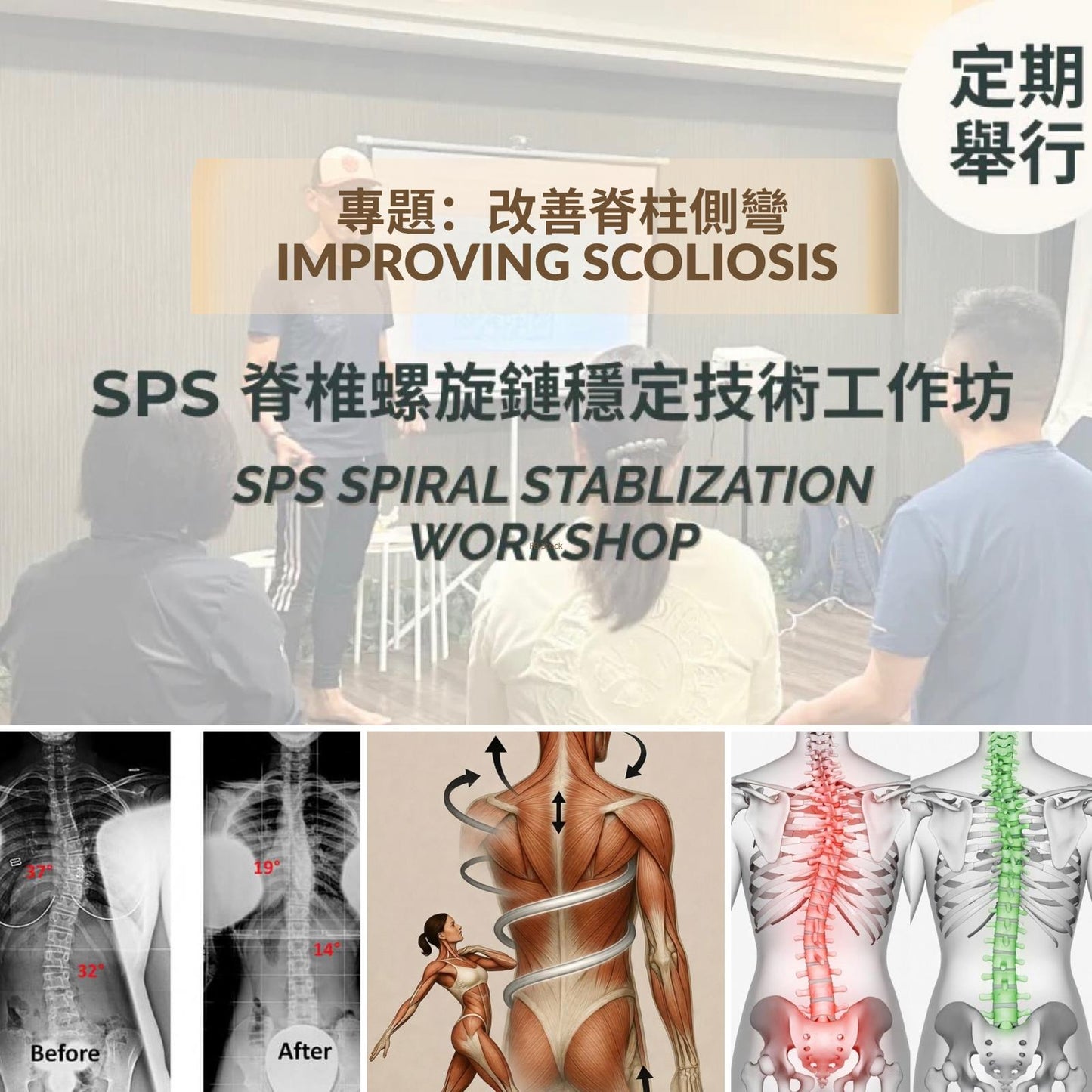
SPS螺旋穩定技術工作坊:脊柱側彎人士必修

Regular price HK$100.00
Sale price HK$100.00 Regular price
早鳥優惠 Sold out

In stock

Session: July 25 (Sat) | 13:30 - 15:00
 

工作坊內容包括:

  1. 介紹捷克SPS系統及原理
  2. 體驗技術訓練帶給你的改善

脊柱側彎是一種脊椎骨向左或向右偏離垂直軸的情況,表現為「C」形或「S」形的彎曲,並常伴隨
椎體的旋轉。在日常生活中,脊柱側彎人士的脊柱容易受到重力、長時間坐姿或不良姿勢的影響,
出現偏移與扭曲。這不僅會影響體態,導致肩膀高低不一、骨盆傾斜或腰部不對稱,嚴重情況下,
還可能引發進行性背痛、心肺功能受損,甚至對健康構成重大威脅。

對抗重力的突破:
SPS(Spiral Stabilization)脊椎螺旋穩定技術是一種透過激活身體螺旋肌肉鏈來促進脊柱穩定的訓
練方法。這項技術可促使脊柱產生縱向牽引力,並激活椎旁肌的主動伸展,有助對抗重力對脊柱的
壓迫,從而達到「反重力減壓」的效果,特別適合脊柱側彎人士。
想了解更多如何運用SPS技術提升脊柱穩定的知識?歡迎參加我們舉辦的《如何運用SPS技術提升脊柱穩定》工作坊

臨床研究支持
根據2025年發表的臨床研究,SPS脊椎螺旋穩定技術在促進脊柱穩定及改善脊柱側彎相關姿勢問題
方面顯示積極效果。
一項研究(Zeng et al., 2025)顯示SPS組在Cobb角、軀幹旋轉角、鎖骨角及自我形象等指標上,
改善幅度顯著優於傳統核心穩定訓練。
另一項研究(Lu et al., 2025)亦發現SPS與Schroth方法均優於傳統訓練,在減少Cobb角及軀幹旋
轉角方面效果更明顯。

相關醫學文獻參考

以下為選取的PubMed醫學文獻 , 供進一步參閱:
查看Zeng et al.研究詳情
查看Lu et al.研究詳情

這些研究為SPS作為保守運動輔助方法提供科學支持,但效果因人而異,建議結合醫生或物理治療
師意見使用。

免責聲明
本工作坊純屬教育及運動訓練性質,並非醫療診治或治療。如有脊柱相關健康問題,建議先諮詢醫
生或物理治療師。 

工作坊詳情:
地點:源・意識科學資源及培訓中心
尖沙咀廣東道12號松鳳商業大廈 6樓 
費用:$100
導師:Edvin (徐仲良)
捷克SPS一階課程培訓講師
SPS一、二、三、四、六及七階國際認証
Booking & Cancellation Policy

1. How to Book
On the booking calendar, select your desired date and time slot, and then click 'Next' to review your selection. Click 'Confirm' and then 'Add to Cart'.

Your selected time slots are reserved and will be held for 30 minutes to complete your booking.

2. Advance Booking Requirement
All reservations must be completed a minimum of 18 hours prior to the scheduled class commencement time.

3. Package/Multiple Slots Booking
Customers should ensure their bookings do not clash when booking for multiple slots at one time.

4. Cancellation and Refund:

  • If the class schedule is changed due to
    typhoons or other force majeure events (uncontrollable factors), a full refund will be issued to participants who are unable to attend the rescheduled session. The organizer will notify participants as soon as the situation is confirmed.
  • In the event of insufficient enrolment, the organizer reserves the right to cancel the course or adjust the date. Participants who are unable to accommodate the new schedule will receive a full refund.

5. Rescheduling
Each booking is allowed to reschedule one time. Rescheduling must be made a minimum of 48 hours in advance of the original class start time. You can manage your booking through the link “Reschedule Booking” in your booking confirmation email.


What to Wear to Class?

Please wear sports tops and pants (preferably form-fitting). Shoes are not permitted in the class area. Please bring your own sweat towel and drinking water.


Terms & Conditions

  1. Participants must be aged 18 or above.
  2. No storage service is provided; participants are responsible for their own personal belongings.
  3. If the Red or Black Rainstorm Warning Signal or Typhoon Signal No. 8 or higher is in force 2 hours before the scheduled time, the class will be cancelled and rescheduled.
  4. Participants confirm that they are in good health, physically capable of participating in this activity, and have not been advised by a medical practitioner that they are unfit to participate.
  5. Photography or video recording may take place during the class. These images and/or videos (whether including the participant’s portraits or not) may be used for future promotional purposes across various platforms without requiring further consent from the participant.
  6. Personal data collected will be used for the purposes of this course only.
 

Why Learn SPS with AWRTC

AWRTC is the only official training centre in Hong Kong authorized to issue the international certification from the Spiral Stabilization (SPS) headquarters in the Czech Republic.

Choosing AWRTC for your SPS learning or gaining the certification means you are not just learning an exercise method, but embracing a comprehensive and modern approach to wellness. We provide a unique learning environment that prepares you to be a confident and effective practitioner.


Conditions SPS Can Help With

  • Herniated Discs & Disc Protrusion
  • Scoliosis
  • Chronic Pain
  • General Spinal Diseases (Prevention and Rehabilitation)
  • Posture Issues, including rounded shoulders, hunchback, flared ribs, and pelvic tilt
  • Pelvic Floor Conditions
  • Postoperative Recovery
  • Postpartum Rehabilitation
 
View full details

Instructor

Edvin(徐仲良)

捷克SPS一階課程培訓講師
SPS一、二、三、四、六及七階國際認証
NASM 矯正訓練專家
EBFA 赤足訓練專家 (一級)
NKT 神經動能治療 (三級)
DNS 動態神經穩定術 (課程A)
Stretching Instructor @HKSEA
TheraBand®️ CLX Trainer
Short Sprints Coach @ALTIS
Distance Running Instructor @AASFP
Corrective Exercise Specialist @NASM
Personal Fitness Trainer @AASFP
Stick Mobility Movement Certified Specialist (Level 2)


faq

What is Spiral Stabilization System (SPS)?

Spiral Stabilization (SPS) is a scientific-based exercise method designed to stabilize the spine. It focuses on activating spiral muscle chains throughout the body to create an upward force that elongates the spine, improving posture and enabling pain-free movement. The system's methods and outcomes are supported by clinical research and established principles of biomechanics, muscle activation, and rehabilitation science.

How does Spiral Stabilization work?

SPS works by engaging specific spiral muscle chains, such as the latissimus dorsi and gluteus maximus, to create a dynamic stabilizing "corset" around the torso. This activation generates an elongating force on the spine, which helps to increase the space between vertebrae. The exercises employ spiraling movement patterns that stretch and strengthen muscles, improve coordination, and stimulate adaptation between agonist and antagonist muscle groups. This process corrects muscle imbalances, improves postural alignment, and helps distribute loads more evenly across the body's major joints.

Is Spiral Stabilization a scientifically proven method?

Yes, Spiral Stabilization (SPS) is presented as a scientifically proven and clinically applied method, supported by both formal research and extensive practical application.

The method is explicitly described as a scientific-based exercise, with its principles and results backed by clinical research, biomechanics, and rehabilitation science. Its effectiveness has been examined in multiple randomized controlled trials. Furthermore, peer-reviewed studies have repeatedly demonstrated that SPS can significantly reduce pain and improve physical function, with outcomes comparable to other established therapeutic protocols like the McKenzie method.

The credibility of the method is further reinforced by its origins and widespread adoption. It was developed over several decades, beginning in 1979, by Dr. Richard Smíšek, a Czech medical doctor specializing in myoskeletal and rehabilitative medicine. His extensive clinical work with patients suffering from spinal pain was the foundation for the system's development. This clinical-first approach is reflected in its practical success and integration into healthcare systems. For example, the SPS method is well-established in Germany, where it has been used for over 20 years and is covered by some medical insurance plans. It is also widely used in its country of origin, the Czech Republic, and has a growing presence in the United Kingdom, Ireland, and other nations through a network of clinics and certified practitioners.

Is Spiral Stabilization effective for children and teenagers?

Yes, SPS is used for both children and adults and has shown significant effectiveness in treating conditions common in adolescents. For example, in cases of adolescent idiopathic scoliosis (AIS), treatment with SPS has been shown to help a high percentage of patients avoid surgery.

What conditions can Spiral Stabilization help with?

Clinical research has demonstrated the effectiveness of SPS for a variety of conditions. It is commonly used in the conservative management of spinal disorders and can be beneficial for:

  • Herniated Discs & Disc Protrusion
  • Scoliosis
  • Chronic Pain
  • General Spinal Diseases (Prevention and Rehabilitation)
  • Posture Issues, including rounded shoulders, hunchback, flared ribs, and pelvic tilt
  • Pelvic Floor Conditions
  • Postoperative Recovery
  • Postpartum Rehabilitation